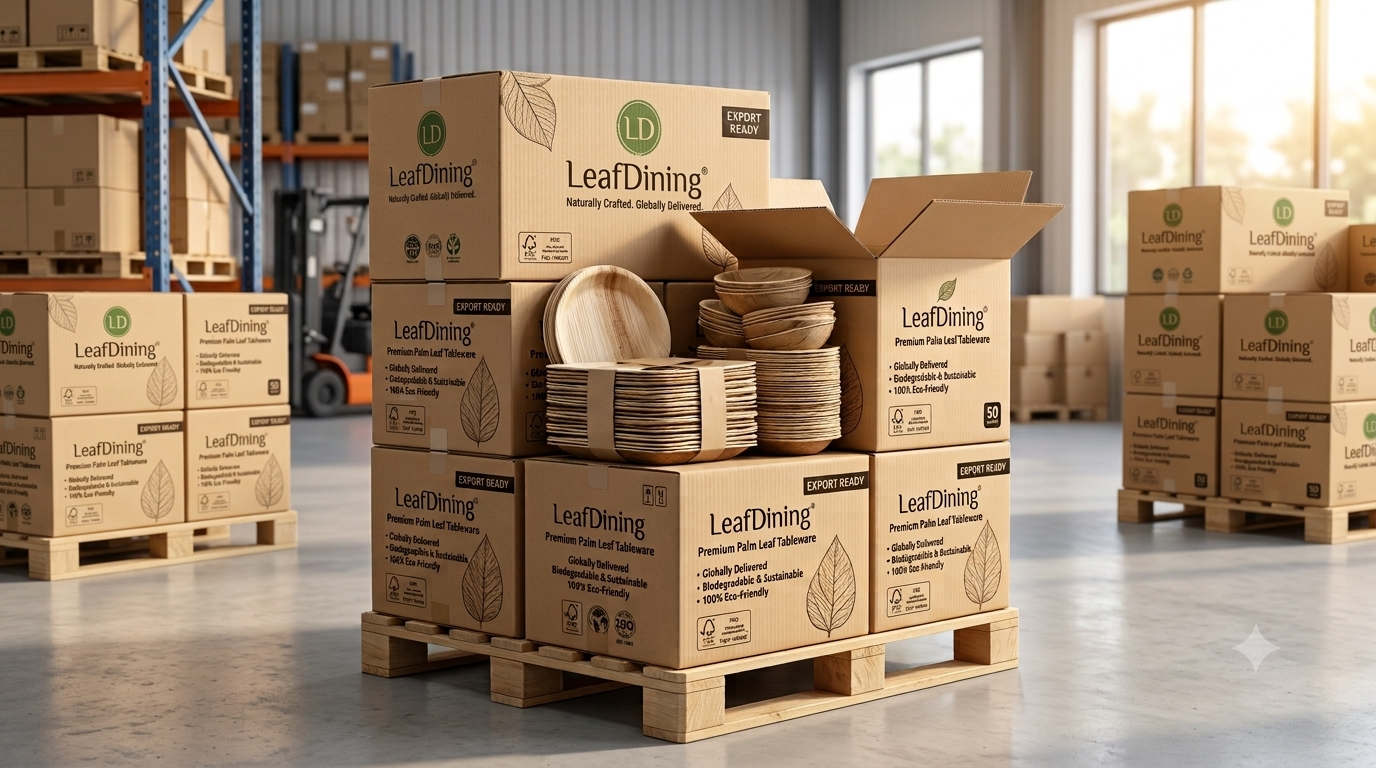


Supplier Evaluation, Container Planning & Procurement Strategy
In Part 1, we explored the growing demand for areca palm leaf tableware and the importance of evaluating quality beyond price.
In Part 2, we discussed export packaging, moisture control, documentation, compliance requirements, and Incoterms.
This section focuses on one of the most important aspects of international sourcing—choosing the right supplier and building a reliable supply chain.
Many importers spend weeks comparing prices but only a few hours evaluating the supplier behind those quotations. In reality, selecting the right business partner often has a greater impact on long-term success than negotiating the lowest unit price.
Pain Point #6: How Do You Know If a Supplier Is Truly Reliable?
One of the biggest challenges for overseas buyers is that they usually cannot visit every factory before placing an order.
Instead, they must make decisions based on:
- Product photographs
- Online catalogues
- Video calls
- Email communication
- Samples
- Third-party recommendations
While these resources are helpful, they do not always provide a complete picture of a supplier’s capabilities.
Experienced procurement teams evaluate suppliers using a structured approach rather than relying on marketing claims alone.
What Professional Buyers Look for Before Shortlisting a Supplier
Price is only one part of the decision.
A reliable supplier should demonstrate consistency across several areas.
Manufacturing Capability
Ask questions such as:
- How many years have you been producing areca palm leaf tableware?
- What production capacity can you handle each month?
- Can you support repeat orders?
- Can production be scaled during peak seasons?
Understanding production capability helps buyers determine whether the supplier can support future business growth.
Product Consistency
Consistency is often more important than perfection.
Receiving one excellent shipment followed by inconsistent quality in later orders can disrupt retail operations and damage customer confidence.
Ask whether the supplier maintains documented production standards and quality inspection procedures.
Communication
Clear communication reduces mistakes.
Reliable suppliers usually:
- Respond promptly.
- Confirm specifications in writing.
- Share realistic production schedules.
- Provide regular shipment updates.
- Notify buyers immediately if delays occur.
A supplier who communicates well before receiving the purchase order is often more likely to communicate effectively during production.
Export Experience
Exporting requires knowledge beyond manufacturing.
Suppliers familiar with international trade generally understand:
- Export documentation
- International packaging standards
- Container loading
- Customs requirements
- Freight coordination
- Labelling requirements
Their experience can reduce the likelihood of delays and documentation errors.
Why Product Samples Are So Important
Many first-time buyers treat samples as a formality.
Experienced importers treat them as an investment.
A sample allows buyers to evaluate:
- Surface finish
- Colour consistency
- Plate thickness
- Strength
- Weight
- Odour
- Packaging
- Overall workmanship
Whenever possible, compare samples from multiple suppliers before making a purchasing decision.
The objective is not simply to find the best-looking sample but to identify the supplier most capable of delivering that same quality consistently across thousands of pieces.
Factory Audits and Quality Assurance
For larger orders, many buyers conduct a factory audit or arrange an independent inspection before production begins.
A factory audit may evaluate:
- Manufacturing facilities
- Production equipment
- Hygiene practices
- Storage conditions
- Packaging operations
- Quality control procedures
- Workforce capability
This provides buyers with greater confidence before committing to significant purchase volumes.
Quality Inspection Before Shipment
Many experienced importers consider pre-shipment inspection to be one of the most valuable investments in international sourcing.
Rather than discovering problems after goods arrive overseas, inspection helps identify issues before the container is sealed.
Common inspection points include:
Product Dimensions
Verify that all products match the agreed specifications.
Plate Thickness
Check for consistency across production batches.
Surface Finish
Inspect for cracks, sharp edges, excessive burn marks, or surface defects.
Product Cleanliness
Ensure products are free from dust, excessive residue, or contamination.
Moisture Condition
Confirm that products appear properly dried before packing.
Packaging
Inspect:
- Shrink wrapping
- PE liners
- Carton quality
- Carton sealing
- Carton labelling
Quantity Verification
Container Planning: Choosing the Right Shipping Option
Shipping costs represent a significant portion of the total landed cost.
Selecting the right container option can improve freight efficiency and reduce transportation expenses.
Less than Container Load (LCL)
Suitable for:
- Trial orders
- Small wholesalers
- Product testing
- Market validation
Advantages:
- Lower initial investment
- Flexible order quantities
Considerations:
- Higher freight cost per unit
- Longer handling process
- Greater risk of cargo movement due to consolidation
20-Foot Container
Often chosen by:
- Medium-sized distributors
- Regional wholesalers
- Businesses expanding into new markets
Provides a balance between inventory investment and freight efficiency.
40-Foot Container
Commonly used by:
- Established wholesalers
- National distributors
- Large restaurant supply companies
Offers better freight efficiency compared to multiple smaller shipments.
40 High Cube (40HQ)
Frequently selected by:
- Supermarket supply chains
- Large importers
- High-volume distributors
The additional internal height provides greater loading capacity for lightweight products such as areca palm leaf tableware.
Important Note
Actual container capacity depends on:
- Plate size
- Product shape
- Nesting efficiency
- Carton dimensions
- Packaging configuration
- Palletisation requirements (if applicable)
Rather than asking, “How many plates fit in a container?”, request a detailed container loading plan from your supplier based on the specific products you intend to purchase.
Wholesale Buyer’s Inspection Checklist
Before approving production or shipment, review the following checklist.
Product Quality
☐ Sample approved
☐ Plate dimensions verified
☐ Plate thickness confirmed
☐ Surface finish acceptable
☐ No visible cracks
☐ Product strength meets expectations
Packaging
☐ Products adequately dried
☐ Shrink wrapping completed
☐ PE liners used where required
☐ Silica gel or appropriate desiccants included (if specified)
☐ Export cartons suitable for international shipping
☐ Cartons properly sealed
☐ Carton labels verified
Documentation
☐ Commercial Invoice prepared
☐ Packing List verified
☐ Bill of Lading requirements confirmed
☐ Certificate of Origin arranged (if required)
☐ Phytosanitary Certificate discussed (where applicable)
☐ Fumigation requirements confirmed (if applicable)
☐ Food contact documentation reviewed
☐ HS Code confirmed with customs broker
Logistics
☐ Incoterms agreed
☐ Production timeline confirmed
☐ Shipping schedule verified
☐ Freight forwarder details confirmed
☐ Insurance discussed where appropriate
Ten Questions Every Buyer Should Ask Before Placing a Purchase Order
Instead of asking only “What is your best price?”, consider asking:
- What quality inspection process do you follow?
- How do you control product moisture before packing?
- What packaging materials do you use for export shipments?
- Can you provide photographs of previous export packaging?
- What export documents will be supplied?
- What production lead time should I expect?
- Can mixed sizes or multiple SKUs be loaded into one container?
- What happens if products arrive damaged or do not match the agreed specification?
- Can you support repeat orders with consistent quality?
- Which countries do you currently export to?
These questions often provide more insight into a supplier’s capabilities than price negotiations alone.
Warning Signs Buyers Should Never Ignore
While most suppliers operate professionally, buyers should remain alert to potential warning signs.
Exercise additional due diligence if a supplier:
- Refuses to provide product samples.
- Frequently changes quoted prices without explanation.
- Avoids discussing quality standards.
- Cannot clearly explain export documentation.
- Gives unrealistic production timelines.
- Responds inconsistently to technical questions.
- Provides incomplete company information.
- Pressures buyers to make immediate payments without proper documentation.
None of these factors automatically indicate a problem, but they should encourage buyers to ask additional questions before proceeding.
Building Long-Term Supplier Relationships
Successful international sourcing is built on partnerships rather than one-time transactions.
Long-term buyers often experience benefits such as:
- More consistent quality
- Better production planning
- Priority scheduling during busy seasons
- Improved communication
- Greater flexibility with customised products
- Better understanding of buyer preferences
Developing a trusted supplier relationship can reduce procurement risks and support sustainable business growth over time.
Key Takeaways from Part 3
Choosing the right supplier involves much more than comparing quotations.
Professional buyers evaluate manufacturing capability, quality systems, export experience, communication, packaging standards, logistics planning, and long-term reliability before making purchasing decisions.
A structured supplier evaluation process can significantly reduce sourcing risks and help establish a dependable supply chain for future growth.
End of Part 3