

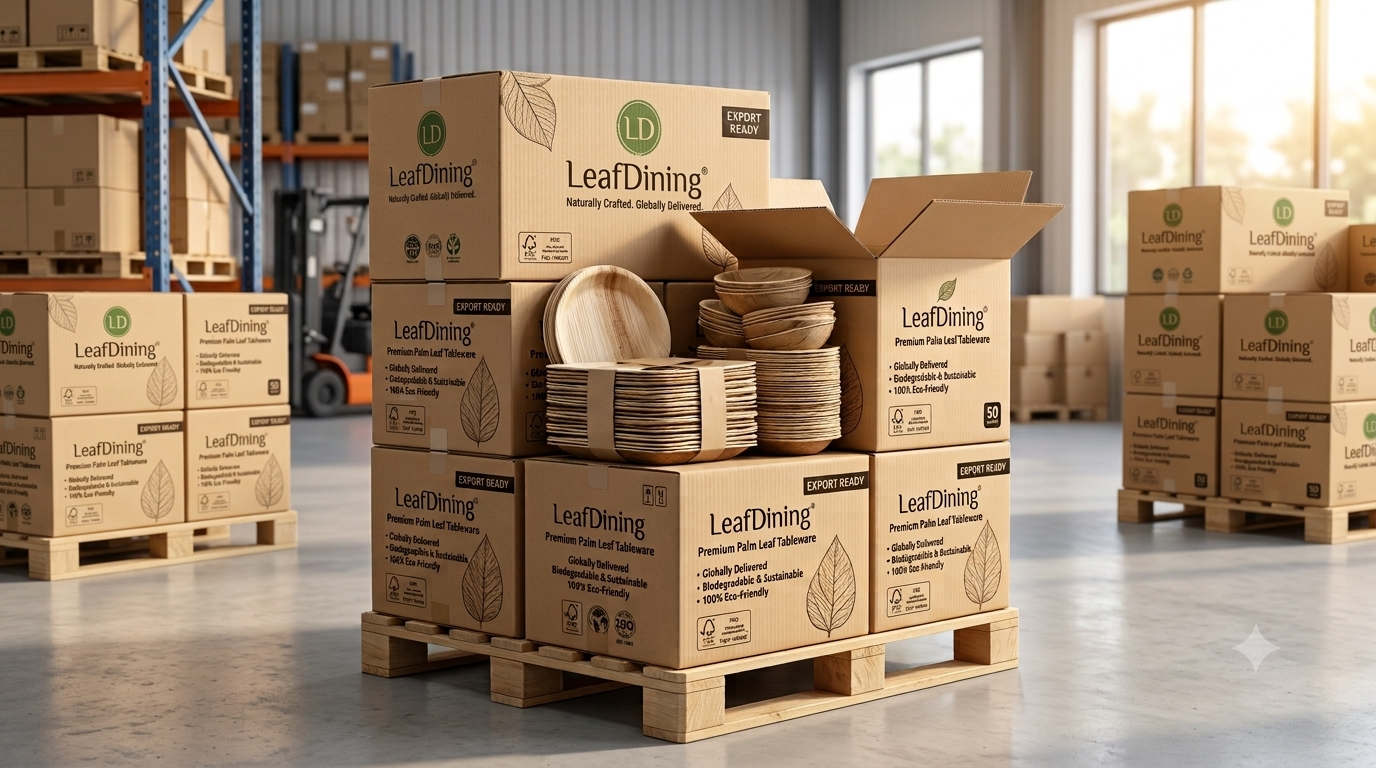
Packaging, Shipping, Documentation & Compliance
In Part 1, we discussed why India has become the preferred sourcing destination for areca palm leaf tableware and explored two of the biggest challenges faced by international buyers—quality inconsistency and choosing suppliers based solely on price.
In this section, we’ll focus on another critical area that is often overlooked until problems occur: packaging, shipping, export documentation, and regulatory compliance.
For many importers, the product itself is only half the equation. The other half is ensuring that the products arrive at their warehouse in the same condition they left the factory.
Pain Point #3: Ocean Freight Can Damage Even High-Quality Products
Many first-time buyers assume that once products leave the factory, the difficult part is over.
In reality, the journey from an Indian manufacturing facility to a warehouse in Europe, North America, Australia, or the Middle East can take 30 to 45 days, and in some cases even longer due to transshipment or port congestion.
During this time, containers may travel through regions with significant changes in temperature and humidity. These changing conditions can create condensation inside the container, commonly known in the logistics industry as container rain.
While areca palm leaf plates are naturally durable, poor packaging and moisture management can lead to issues such as:
- Moisture absorption
- Mould growth
- Damaged cartons
- Deformed plates
- Unpleasant odours
- Product contamination due to compromised packaging
For businesses supplying supermarkets, restaurants, or retail chains, even minor transit damage can lead to rejected deliveries, customer complaints, or financial losses.
Why Export Packaging Matters
Export packaging is not simply about placing products into cartons. It is designed to protect the shipment throughout international transportation, warehousing, customs inspections, and local distribution.
Experienced exporters generally pay close attention to several packaging factors.
Moisture Management
Finished products should be adequately dried before packing. Many experienced exporters aim for a moisture content of approximately 8–10% to reduce the likelihood of mould growth during extended sea transit.
Protective Wrapping
Bundles are often shrink-wrapped or packed inside food-grade polyethylene (PE) liners to reduce exposure to ambient moisture.
Desiccants
Silica gel or other approved desiccant packets are commonly placed inside cartons to absorb excess humidity during transit.
Strong Export Cartons
For export shipments, durable corrugated cartons—often 5-ply or stronger depending on customer requirements—help protect products from compression, stacking pressure, and handling during transportation.
Carton Labelling
Clear carton labels improve warehouse handling and inventory management. Typical information may include:
Customer-specific labels or barcodes (where required)
Product description
Plate size
Quantity
Batch number
Country of origin
Ask Your Supplier These Packaging Questions
Before placing a wholesale order, ask your supplier:
- What moisture-control process do you follow before packing?
- Are silica gel packets included in export cartons?
- Are products packed in PE liners or shrink-wrapped bundles?
- What grade of export cartons do you use?
- Can you share photographs of export packaging?
- Do you palletize shipments if requested?
- How do you protect products against container condensation?
These questions often reveal how experienced a supplier is with international shipments.
Pain Point #4: Export Documentation Can Delay Your Shipment
One of the most common reasons for customs delays is incomplete or inaccurate documentation.
Unlike domestic trade, international shipments require multiple documents that must match each other accurately. Even small inconsistencies in product descriptions, quantities, or invoice details can result in delays, additional inspections, or unexpected costs.
While documentation requirements vary depending on the importing country, buyers should understand the purpose of the key export documents.
Commercial Invoice
The commercial invoice is the primary sales document used by customs authorities. It includes product descriptions, quantities, pricing, Incoterms, buyer and seller details, and payment terms.
Packing List
The packing list provides detailed information about the shipment, including carton count, net weight, gross weight, dimensions, and packing configuration. It helps customs officials and freight handlers verify cargo.
Bill of Lading
Issued by the shipping line, the Bill of Lading serves as evidence that the cargo has been received for shipment. It is also an important transport document used during customs clearance.
Certificate of Origin
Some importing countries require a Certificate of Origin to determine applicable import duties or eligibility under trade agreements.
Phytosanitary Certificate
Because areca palm leaf plates are manufactured from natural plant material, certain countries may require a Phytosanitary Certificate issued by the relevant plant quarantine authority. This certificate confirms that the products meet the importing country’s plant health requirements.
Requirements vary between countries, so buyers should confirm local regulations before shipment.
Fumigation Certificate
Depending on the destination market, shipping method, or packaging materials used, a Fumigation Certificate may also be requested. Although areca palm leaf plates undergo heat pressing during production, import regulations differ across countries, making it important to verify destination-specific requirements.
Food Contact Compliance
Since areca palm leaf plates are intended for serving food, buyers should discuss food-contact compliance with their supplier before confirming an order.
Depending on the destination market, customers may request supporting declarations or laboratory test reports demonstrating that the products are suitable for food contact.
Examples include:
- FDA-related documentation for the United States, where applicable.
- EU food contact compliance declarations or relevant test reports for European markets.
Import requirements vary by country and product application. Buyers should consult their customs broker or regulatory advisor to determine the documentation needed for their specific market.
Understanding HS Codes
One topic that often creates confusion for new importers is the Harmonized System (HS) Code.
An HS Code is an internationally recognised tariff classification used by customs authorities to identify products and determine applicable duties, taxes, and import regulations.
For areca palm leaf tableware, customs classification may differ depending on the specific product, its composition, and the importing country’s tariff schedule.
Commonly Referenced HS Codes
Importers may encounter tariff headings such as:
- HS Code 4602.19 – Articles made from vegetable plaiting materials (commonly referenced for certain palm leaf products).
- HS Code 1404.90 – Other vegetable products not elsewhere specified (used in some jurisdictions for natural products).
Important: The correct HS Code should always be confirmed with your customs broker or import consultant before shipment, as classification decisions ultimately rest with the customs authority in the destination country.
Using the correct HS Code helps reduce the risk of customs disputes and unexpected duty assessments.
Pain Point #5: Private Label Orders Require More Planning Than Many Buyers Expect
Private-label products allow businesses to build their own brand instead of selling generic tableware. While this offers significant commercial advantages, it also introduces additional planning requirements.
Unlike standard wholesale orders, private-label projects often involve multiple approval stages.
These may include:
- Brand logo placement
- Retail packaging design
- Barcode integration
- Product labels
- Master carton artwork
- Marketing inserts
- Country-specific labelling requirements
Each revision can affect production timelines, so artwork approval should be completed well before manufacturing begins.
Common Mistakes in Private Label Projects
Experienced buyers recommend avoiding these common errors:
- Submitting low-resolution artwork.
- Making design changes after production has started.
- Forgetting mandatory retail labels.
- Ignoring barcode placement requirements.
- Failing to approve packaging proofs before printing.
Clear communication between buyer, designer, and supplier helps minimise delays and additional costs.
Understanding Incoterms Before You Buy
Pricing alone does not tell the full story. Buyers should also understand the Incoterms used in quotations, as they define which party is responsible for transportation, insurance, customs formalities, and risk at different stages of the shipment.
Some of the most common trade terms include:
EXW (Ex Works)
The buyer assumes responsibility for collecting the goods from the supplier’s premises and arranging transportation from that point onward.
FOB (Free on Board)
The supplier delivers the goods onto the vessel at the agreed port of shipment. Responsibility transfers to the buyer once the goods are loaded on board.
CIF (Cost, Insurance and Freight)
The supplier arranges transportation and marine insurance to the destination port, while the buyer typically handles customs clearance and inland transportation after arrival.
DDP (Delivered Duty Paid)
The supplier assumes responsibility for delivering the goods to the buyer’s specified location, including transportation and, where agreed, applicable import duties and taxes.
Choosing the right Incoterm depends on your logistics experience, destination country, and preferred level of control over the shipment.
Key Takeaways from Part 2
Before confirming a wholesale order, buyers should ensure that they have discussed:
- Export packaging methods.
- Moisture-control procedures.
- Use of silica gel or other desiccants.
- Export carton specifications.
- Required shipping documents.
- Applicable certificates.
- Correct HS Code.
- Food-contact compliance.
- Private-label requirements.
- Appropriate Incoterms.
Addressing these topics before production begins helps reduce misunderstandings, minimise delays, and improve the likelihood of a smooth import experience.
End of Part 2